Sunday, February 19, 2012

Tian Ping Shan

 About two blocks away from our apartment is the Eastern end-of-the-line for city bus #4.  If you get on the bus at that stop and ride to the Western terminus you will travel for about 15 miles as the crow flies.    The bus snakes its way through busy streets so that the trip takes about 75 minutes and probably covers 20 or more miles on the road.  You cross the old city of Suzhou on the South side and then traverse the entire Suzhou New District.  It's a cheap trip at 2 RMB - only about 30 cents.  (You gotta love the price of public transport.)
 At the other end of the line is Tian Ping Shan, a hill of about 800 feet that has become a public park and scenic area.  Shan in Chinese (is the character) means a mountain or a hill and anything in between.  The land around Suzhou is so flat that 800 feet qualifies as a mountain of sorts.  Tian Ping Shan is one of many shans that ring Tai Lake and create a hard barrier limit to Suzhou's Westward growth.
 A payment of 10 RMB buys you a ticket to enter the park and climb to the top.  The area is almost entirely tree-covered and seems pristine and rustic, though nothing is China is truly undisturbed by man.   People have been crawling through these hills and building trails and temples and fortifications for thousands of years.  It is still a bit of a sacred place.  (In the top photo, that is a Buddhist monk on the stairs ahead of me.)  At the foot of the hill are several temples and tea houses and attractions (horseback riding, archery, playground for children, and so on.).  There are also several paths leading up Tian Ping Shan.
 A good portion of the climbing trail is covered with stair steps, placed upon or carved into the mountain stone.  But don't mistake that as making this an easy climb.  You are never more than one step away from having a really, really bad day.   Many of the stone steps are worn smooth as glass.  The path is slippery when it is dry....I can hardly imagine it on a typical rainy Suzhou day.  Safety features are non-existent.  If you slip and fall, then it becomes a contest between you and gravity.  Gravity will probably win a convincing victory.
 Still, it was a nice day and the opportunity to climb was impossible to resist.  So I lumbered up the steps and squeezed between the narrow passages with deliberate slowness.   There were quite a few local folks out enjoying the day too.  Just to humiliate me, they climbed with reckless abandon and no fear whatsoever.  Parents let their kids scurry over rock faces.  Women in skirts and dress shoes danced past me on the steepest parts.
 Along the way there were little shrines and grottoes for those who were climbing for mystical reasons.  For the tourists, there were a lot of places to look down upon the town of Suzhou below.  As you can see from the photo above, the visibility was not good.  Days of celebration had not helped the situation.  I figure the 6 million residents of Suzhou blew up a couple of million pounds of black powder and maybe burned again that much incense at the temples.   The newspaper said that the pollution index had gone off the charts during the New Year festival - particulate levels were over 5 times higher than the normal health alert limits. 
  As I kept climbing, I was filled more and more with a sense of pride and accomplishment.  The burn my thigh muscles was giving me an exercise high.  And the city below seemed like a small thing, a distant world of mere mortals.  And I was now high enough to see the other shans to the West toward Tai Lake.   I figured that there would be a place at the top to do high-fives with all the other supermen that conquered the mountain.
Pride goes before the fall.  Just to burst my bubble, at the top of the mountain were a bunch of carnival game booths and trinket shops.  There were little kids playing ring toss for prizes.  There was a place to shoot at balloons with a BB gun.  And all these booths were run by people my age or older.  I figure that every morning at sunrise they strap all this stuff on their back and hump it up the side of the hill.  And every evening the go back down again.  After about 15 minutes at the top, I packed up my wounded ego and stumbled back down to the bottom.

The Twin Pagodas

On the second day of the New Year holiday, I took the 307 bus to downtown Suzhou.  The bus conveniently stops near the pedestrian shopping district.  A stop or so before reaching that destination, I noticed a couple of spires peaking above the rooftops to the South.  I'd heard before of a set of twin pagoda's in the area and figured that these spires must belong to them.  So I decided to go exploring that direction before shopping.  I took a side trip through the city park first.  Then I went looking for the pagodas.

It was actually harder to find than I'd originally thought it would be.  Funny thing about Suzhou is that it may have a lot of historical sights (and sites), but most of them are hidden behind walls and nearly invisible from the streets.  Even these tall pagodas were difficult to locate.  The streets are so narrow that you can't get a good angle to see them over the tops of the two-story houses.
But I did find the Twin Pagodas, finally.  The pagodas were originally part of a sprawling temple complex built during the late tenth century, during the Song Dynasty.  There is not much left here other than the pagodas.  They're all that remain of the temple, which was destroyed when the British army came to visit in 1840, in what we now call the First Opium War.   In the top photo of the pagodas you can see a some stone columns and a few more stone foundations that once supported more columns.  These are the temple ruins, left as a reminder.

The sizable stone columns suggest that the original temple must have been impressive.  Most of the temples I've seen, even the older ones, are constructed primarily of brick and timbers.  The foundations here indicate a significant structure under roof.  It must have been well decorated too.  On display are a good number of stone carvings that were rescued.  The photo above is an example.
Next door to the twin pagodas is the Ding Hui temple, a smaller temple that was built upon the ruins.  It is a functioning Buddhist temple for the community.  People come to burn incense and offerings as part of their prayers.  The photo above shows a shop on the street which sells the variety of combustibles used by the faithful.  Red, as you might guess, is an auspicious color for such things.  On the table, to the left, are piles of large and small incense sticks.  To the right, lying horizontally, are red wax prayer candles.
Even the temple dogs were decorated with red for the Holiday.  Inside the temple, below, there were not so many people.  I didn't want to take too many photographs because this was not a tourist place.  For once, I figured I would give a little privacy.   I did get caught up in a conversation with a very nice Buddhist monk who spoke very good English.  He was a young fellow - I'd guess in his mid-twenties.  He didn't try to proselytize.  But he was curious to talk about what Christians believe in.   He was benchmarking.
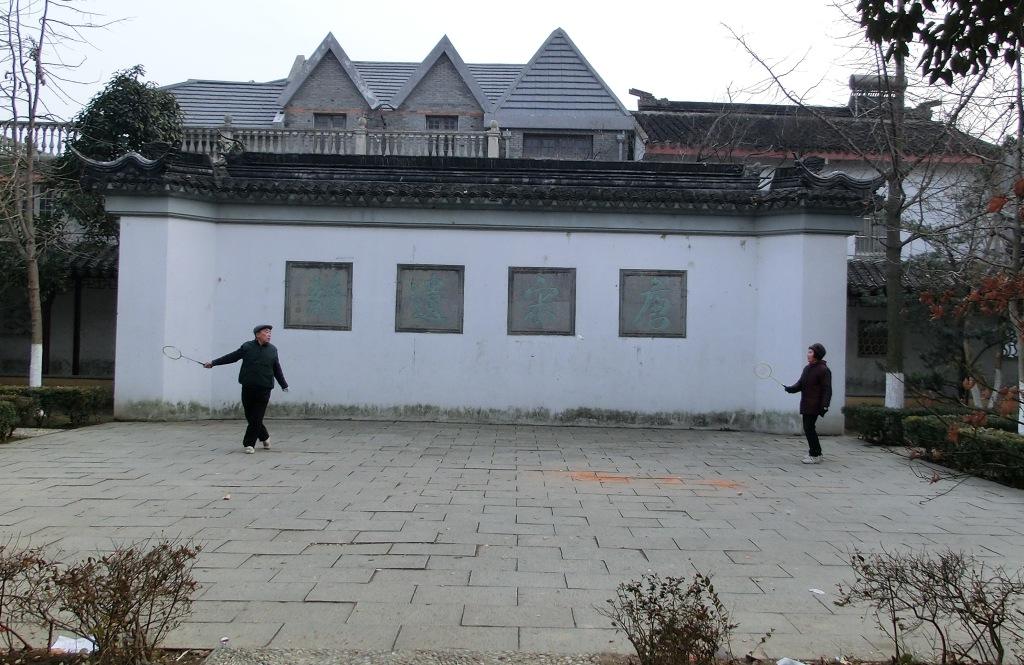
The temple and pagodas are located on a narrow lane in an otherwise residential neighborhood.  A few folks were out strolling.  The photo below shows an elderly couple playing badminton.  Burning off a few calories after the holiday feast, I suppose.  Badminton is popular here, and you see a lot of parents and children playing in the parks.   I thought this couple was cute.  If you look closely at the man on the left, you can see him pivoting gracefully on his toes as if he were doing Tai Chi.

Sunday, February 12, 2012

Music in the Park

There is a small city park near the center of the old city of Suzhou.  The people I work with - the younger people - joke that the park is a place for old people to go to.   And so it is.  If you walk through the park in the morning you will find older citizens practicing their Tai Chi.  As morning turns to afternoon, the park fills will grandparent-baby-sitters.  I think the grandparents come there as couples, usually pushing their prized grandchild in a stroller.  Once in the park, the couples split and regroup by gender.  Groups of older men gather under the trees and argue with each other and share cigarettes.  There is a similar gravity that draws all the grandmothers and the strollers together.  I'm not sure, but I think they take turns bragging on their grandchildren.  That is a safe guess.
On week-ends and holidays and warm summer evenings, the park fills with music.  People with talent bring their musical instruments.  People without talent bring a boom box.  People sing.  People dance.  People just enjoy themselves and enjoy being with their neighbors.  They sing all the old songs and, in the process, teach them to the grandchildren.  I suppose this is what village life was like in the days before air conditioning and television and 1500 square foot apartments.  People have gathered around the village commons like this for thousands of years, to share a common fire and to make their own entertainment.  In the truest definition,  "community" is not a collection of buildings, but rather is a collection of people who are actively living with one another.

The modern world has a way of killing off the old definitions of community.  In the U.S., I think that suburbs and air conditioning and television have pretty much erased the traditions of barn dances and community gatherings.  I suppose that in China, the modern world will win in the end.  Maybe these gatherings in Suzhou park are the last vestiges of a dying tradition.  Maybe the current generation - my co-workers - will opt to spend their retirement years surfing the Internet rather than to go out and sing, or dance, or argue with others under the trees in the park.
The holidays of New Year brought out the people in Suzhou City Park just as if it were a week-end or warm summer evening.   On the second day of the New Year holiday, I found several groups of people playing traditional instruments and music.  These were not professional performers or buskers.  No one had a hat out for donations.  It was cooperative Karaoke.  A person in the crowd would take the microphone and ask the old musicians to play a song.  The musicians would play and the person with the microphone would sing.  After the song, everyone would clap.  Then someone new would grab the microphone and request another song. 
I love the faces of the old musicians.  These are old guys.  Workers.  Farmers.  Fathers. Grandfathers.  People who struggled through the hard times of the 1960s and 1970s and sacrificed so that their children and grandchildren might  have better opportunities.  Maybe I'm sentimental, but their faces remind me of my grandfather.  Faces hardened by a hard lives, but the eyes still showing  warm hearts inside.
Not all the people in the park come to sing.  Some come to dance.  There is an pavilion that serves as the community dance floor.  Someone...I don't know whom...brings a monster boom box and sets it up on the grandstand.   The play list varies from traditional Chinese music to country-western to disco.  The people dance. They waltz.  They boogie.  They line dance.  Some of the couples appear to be man and wife.  Other couples appear to be grandmothers killing time dancing together while their husbands are arguing and smoking cigarettes under the trees.
Karaoke is big in China.  The photo above shows and enterprising fellow that has built a portable karaoke studio on the back of an e-bike.  You can see a lady, just right of center, holding the microphone and singing away.  The bike...the pink and red thing...is actually a tricycle.  Between the two rear wheels are a huge battery pack that is used to drive the loudspeakers and computer equipment.  You can see a blue plastic bench atop the seat.  On top of that, there is an LCD monitor.  The man hunched over the tricycle is managing the laptop computer that drives the whole thing.   The people come and request a song.  The man pulls up the song from the laptop.  The song plays and the monitor displays the words for the singer to sing along.
There is more than just music going on in the park.  The photo above shows people fishing in the park ponds.  I don't think there is a fish in that pond more than two inches in length.  But the people go crazy to rent fishing poles and buy bait as if they were on a fishing holiday in Canada.
The photo above shows a calligrapher writing poems on the sidewalk of the park.  Chinese characters are traditionally written by brush and ink.  It is a difficult skill to master, even with a small brush held in hand.  This gentleman is generating perfect characters using a four foot brush.   The people appreciated his skills as much, or more, than the musicians'.

Saturday, February 11, 2012

New Year's Day

When the sun rose on New Year's Day, the fireworks started again.  Compared to the noise levels the night before, it seemed anemic and half-hearted....like a few people stayed up to greet the sunrise, and then immediately crawled back into bed.  By 10:00 a.m. it was relatively quiet and safe to go out onto the streets.   The streets were covered with the red confetti of exploded firecrackers and littered with piles of charred cardboard tubes from Roman Candles.  The biggest piles were in front of the apartment complexes. 
We met up with a couple that is new to Suzhou, and took them up the Tiger Hill.   We were hoping that there might be some kind of spectacle going on there....like dragon dances or performances.  No such luck, though.  The garden was nicely decorated with lots of red and gold lanterns.  And there were a lot of people there.  But nothing of unusual value associated with the New Year.
It was a pretty day though, and a lot of people had brought their families out for a walk through the park.
I'm pretty sure that they were predominately local folks, and not the normal bused-in-tourist crowds.  The normal tourists should be spending the holidays at home with their families.  The Tiger Hill visitors we saw were probably Suzhou people - people desperate for a chance to get out of the house after being locked up with family for the last 24 hours.   It was an opportunity to burn a few calories and get a break from endless games of mah jong or the ceaseless chattering of an Aunt or Uncle.
After walking Tiger Hill, we took a canal boat back to the ShangTang Street shopping area.  It was packed with people too.  The shops were tempting people with holiday gifts....like food or year-of-the-dragon charms.  Probably 95% of the stores in Suzhou were closed on New Year's Day, but here most every shop was open.    Tradition stands no chance when pitted against profit motive.
Food is a popular gift for the holiday.  Fresh fruit is probably the most popular of all the food gifts.  Miniature tangerines seem to be specifically linked to the holiday.  In the photo below you can see the fruit baskets and tangerines on display. 
Tulips are also linked to the New Year holiday.   It's too early for them to bloom naturally, so people buy the bulbs in December and force them to bloom indoors.  The  photo below shows some of the large tulip displays that were seen at Tiger Hill.
And, of course, there were red lanterns hanging up everywhere.  Just as Christmas brings out the evergreen trees everywhere, so too does Chinese New Year bring out these red decorations.

New Year's Eve

China is known for fireworks.  The reputation is well-earned.   Once the sun set on New Year's Eve, then the fireworks started.    Once they started, they really didn't stop for a week.  There were periods when they slowed down.  But they never really stopped.  We went to bed with the sound of fireworks outside.  We were usually awakened by the sound of fireworks breaking out again at dawn.

The Rainbow Walk down along JinJi Lake had a good crowd for New Year's Eve.  A number of people came down to watch the normal water and light show.  The show was scheduled for each night during the holiday period.  Prior to the show, they had a special fireworks display out over the Cultural Center.   The festivities began each evening at 8:00 pm.   That is the top photo.
 After the water show, the JinJi Lake area had a lot of people hanging on to send up paper lanterns for the new year.  The photo above shows them out fighting the wind and drizzle.
The public displays were a minor fraction of the fireworks.  The majority were set off by individuals. They were going off all over the city, as far as the eye could see.  It seemed that a lot of folks came out around 7:00 pm to shoot them off.  I assume this was to break up the boredom after they'd finished their main family meal.   There were explosions everywhere.  They echoed off of the buildings so that every "boom" was followed by three or four reflective booms.  If you were outside, you couldn't carry on a conversation for the noise.  If you were inside, you had to talk over what sounded like rolling thunder.

The fireworks peaked at about 9:00 pm and then tailed off to a calmer pace.  But this was just a pause.  As midnight approached, it seemed as though the dogs of war were unleashed.   Our apartment is 14 stories up in the air, and from our windows we can see pretty far off across the city.  As near and far as the eye could see, fireworks were exploding.   They exploded right next to our apartment windows.  And they exploded all the way across the city to the limits of the horizon. 

If you are old enough to remember the First Gulf War, then you probably remember the images televised by CNN from Baghdad.....of the anti-aircraft guns lighting up the night skies.  It was kind of like that.  But instead of anti-aircraft, it was the Roman candles and flash/bang rockets set off by several million Suzhou revellers.  The photo above is the closest I can come to a representative photo......you kind of see the many flashes of fireworks out over JinJi Lake as far as the eye can see.

A Walk Around Town on New Year's Eve

 New Year's Eve, by the lunar calendar, fell on Sunday, January 22.  With the coming of midnight, and New Year's Day, the year of the Rabbit would end and the year of the Dragon would begin.  It was not a very pretty day in Suzhou.  The skies were grey and it drizzled rain the entire day.  But it was tolerable enough to take a walk around town.

 The New Year's Holiday is a big deal.  It is the most significant holiday of the year, by far, in China.  It's tempting to compare it to the Christmas season, because there are a lot of similarities.  It is a time of family gatherings and gift giving and special foods.  And just as Christmas traditions vary from country to to country, so too do the New Year traditions vary between the regions of China.  But the analogy to Christmas only goes so far.  The Lunar New Year share similarities with Christmas, but it is not the same.
Tradition demands that the New Year holiday be spent with family.  Family means extended family....including grandparents, parents, aunts, uncles, and cousins.  In the old days, the New Year gatherings would be huge family reunions.  These days, due to the one-child policies, there are fewer aunts and uncles and cousins.   But still, the expectation is that everyone get together beginning on New Year's eve.  For several days the families gather and they eat the special holiday foods and they play cards and mah jong and they honor the memories of those no longer living.

They also shoot off a lot of fireworks.  But that is another story.

The mandate to spend the holiday with family, more than any other factor, determines the character of the holiday.  The New Year holiday is a time of travel nightmares. In the week before new year,  1 billion people strain the roads and the railways and the airports to the breaking point.  And a week later they strain it all again when they return home.   In the old days, China was mostly farming communities in which families could reunite by walking a few blocks within a village.  In these days of urbanization, people flee the large cities to return to their ancestral homes.  Or they pick a neutral tourist location for all the family to gather.  

Regardless, the travel statistics are stupefying.  The airports are clogged by tens of millions of travellers, much like the U.S. airports at Thanksgiving.  But by far, the biggest portion of people travel in China by train.  Imagine if one day, the entire population of the U.S. woke up, ate breakfast, and then all went to the local train station.  That is what it is like.  Over 300 million people travelling by train.  A few hundred million more travel by car and by bus.

I'd heard horror stories about train travel.   Train tickets go on sale two weeks before scheduled departure.  They open up 30 extra ticket windows for the holiday, but people still end up waiting in line for two days to buy train tickets.  I went to the Suzhou railway station on the after noon of New Year's Eve and found it to be much less dramatic.  As the second photo shows, the railway station was crowded....but not much more so than on a normal day. 

One possible explanation for the relative calm at the railway station; this was the first year that the China Railway System provided an on-line option for booking tickets.  The newspapers said that, during the week before the holiday, the on-line ticket booking web sites were getting over 1 billion hits per day.
 In Suzhou on New Year's Eve, things were relatively calm.  Relatively dead is perhaps a more accurate description.  Since Suzhou has grown rapidly in the last 20 years, it means that most of the people are from someplace else.  Most of those people had gone back to someplace else....and the town was comparatively deserted when I took my walk around Suzhou.

A lot of the doorways were decorated for the holiday.  The Chinese doorway decoration is not like those we saw in Japan.  In China, the typical decoration is as set of three banners that frame the doorway - a vertical banner on each of the left and right door jambs and a horizontal banner across the top.  The banners are inscribed with a poem or a good-luck saying.  They are almost always written in gold letters on a red background, as shown by the photo above.  Red and gold are auspicious colors.
 Food is a big part of the New Year's Eve celebration.  My understanding is that people sit down together for a big meal, and then graze for another 6 or 7 hours as they wait for midnight to come.  I stopped by the Auchan Supermarket to get some things and it was crazy with last minute shoppers filling out their menus.  The Auchan in Suzhou is the largest supermarket I've ever seen in my life.  It has 110 check out registers, and all 110 were being used.  The people were 5 or 6 deep at each one.  I swear there were 20,000 people in that store.  At least that many.  I kid you not.

The photo above shows a lady who had already gotten her shopping out of the way.  I found her on a side street in the old city, drawing water from a well to wash her vegetables.
 Not everyone in Suzhou was on the ball for the holiday.  The photo above shows a doorway for which the owner needs a wake-up call.  Not only is the "Merry Christmas" decoration over a month old, but the rabbit decorations are a year off.  2011 is the year of the rabbit.  2012 is the year of the Dragon.
Finally, the photo above has nothing to do with the holiday.  But I thought it was interesting.  The photo shows how the horizontal surfaces of an apartment have been fitted out with broken glass to discourage climbers.  The use of broken glass is not unusual - you see it all over Suzhou (and other countries) to top off walls.  It is a cheap substitute for razor wire.  But the owner of this apartment is clever.  He has set full sheets of glass in the top of the wall.  They serve as both deterrent and as a burglar alarm.  No one can climb on top of this wall without causing the full panes of glass to break off and shatter noisily.  And of course, after breaking, the panes of glass will leave some nasty shards for any burglar to climb over.

Tuesday, February 7, 2012

North Temple Pagoda

Many of the holidays in China are based upon the lunar calendar.  Like the Easter holidays of the Christian world, they end up being moveable feasts when you overlay them onto the Gregorian Calendar.   The holidays may land in mid-week or on week-end and, from one year to the next, they may even land in different months.  Working people, though, like to have a predictable vacation schedule.  So  businesses and factories manage the variability by shuffling the workdays during the holiday period.
The Lunar Year of 2012 began officially on Monday, January 23.  The government-mandated holidays for China were the Monday, Tuesday, and Wednesday.  Traditionally, though, people consider the entire week to be a holiday - beginning on New Year's Eve and lasting through the fifth day, which this year would be Friday, January 27.  So no one wanted to work Thursday and Friday, January 26/27.  If you tried to make them work those days, very few would show up.  So most businesses and factories in China shuffled the days as follows:
  1. Saturday, January 21 became a workday.
  2. Sunday (New Year's Eve) was a normal non-working week-end day.
  3. Monday, Tuesday, and Wednesday were official non-working national holidays.
  4. Thursday was a non-working day, in trade for the day of work on Saturday, January 21.
  5. Friday was a non-working day, in trade for a day of work to be done on Sunday, January 29.
  6. Saturday was a normal non-working week-end day.
  7. Sunday, January 29, became a workday in trade for Friday, January 27.
The good news is that, as a result of all that shuffling,  people get to be off work for a full seven days-in-a-row.  The bad news is that the week before and the week after both turn into six day work weeks.
I didn't work on Saturday, January 21.  I started my holiday early.  I took a day of vacation and went to the North Temple Pagoda in Suzhou.
The North Temple Pagoda is part of a Buddhist complex in the old city of Suzhou.  It sits on the same street as the Humble Administrator's Garden, but about a three quarters of a mile to the West.  The pagoda is nine stories tall, and rises about 240 feet into the air.  In the North of the old city, it is the tallest structure around.  It is one of several buildings within the Buddhist temple complex, which is still and active place of worship.  Monks live in the temple dormitories and meditate in the adjoining gardens and walking paths.
The current version of the North Temple Pagoda was built around 400 years ago, during the Ming Dynasty.  It is not as old as the pagoda at Tiger Hill, but it is about one-and-a-half times as tall.  And it is in much better repair.  Tiger Hill Pagoda is an architectural ruin that tilts and looks to be in danger of falling over.  You are not allowed to go inside.  North Temple Pagoda is still a functioning building that you are allowed to climb to the top.  The stairs are steep and dark and booby-trapped with lots of head-bump hazards.  But once at the top, you get a great view in all directions of the old buildings of the old city of Suzhou.
All the photos above are taken from one point or another within the temple complex.  I think you can figure them out based upon the preceeding story.