Sunday, August 5, 2012

Blue Skies

 A few postings back, I complained about how gray and overcast and smoggy the weather has been.  As if to prove me a liar, the skies cleared about three weeks ago and we've had day after day of blue skies.  Real blue skies....sometimes with puffy white clouds, as the photo above shows.  At night, you can see the lights all the way to the horizon and you can see stars in the skies.
 Now, I don't think I'd seen 15 days with blue skies in total over the last year-and-a-half.  Since mid-July, we've had them every day.  In the mid-day sun the temperatures get up into the mid to upper 90s. (35 degrees C. or above).  But the humidity doesn't seem as crazy as it did last summer.  It is still humid - more so than in Indiana I think.  But it is not crazy-stinking-tropical-humid.  In fact, the blue skies have also been accompanied by strong breezes (also an odd thing for summer in Suzhou).  The breeze actually feels cool when it hits you, instead of like a jet of steam from a busted heating pipe.

We owe the good weather to the typhoon season.  Normally, during June, the weather patterns that bring the plum rains also keep the typhoons to the South.  Since the end of the rainy season (which was not very rainy this year) the typhoons have been coming Northward into the East China Sea.  Like a huge vacuum cleaner, they suck out the stagnant air.  They keep the breezes going too.
Most of the Suzhou Expat wives and kids have flown home for the long hot summer.   There are just a few of Theresa's friends left in town.  Within our apartment complex, the  few summer lingerers have been spending almost every day down at the swimming pool, enjoying the glorious weather.  Difficult to see, but in the photo above you might make out a train of children being pulled around the pool on their little floaty toys.

They Paved Paradise

Several times now, we've posted on the construction of the "pair of pants" building.  In the the time we've been here, we've been buffered from the hub-bub of the work by the acres of green space that surround the construction site.  The trees lining the sidewalks seemed to knock down much of the noise.  In the springtime, it was fun to watch the kite-flyers and model-airplane-crashers play out in the open fields.  Last summer, the low spots in the field were turned into lotus ponds, and we enjoyed the lotus flowers for most of the summer.  
Note the use of the past tense in the previous paragraph. 

Sometime March, they began removing all the trees which lined the sidewalks.  This was actually an interesting process to watch.  A tree would be selected and a team of workers would dig a circular trench around the base....by hand with spades and pick-axes.  Then they would begin the process making a root-ball with a netting of ropes.  At the base of the trench, they would start undercutting the roots and would work the rope netting underneath also.  Finally, as shown in the photo above, they would cut through the final roots and tip the tree over on its side. 

They must have done this to 60 or 70 trees....if not more.  I don't know if they are able to replant them someplace else.  The root balls seem too small for that.
They also brought in truck-load after truck-load of concrete Lincoln logs, as shown by the photo above.   They would make a pile of these, and then after a while they would take down the pile and reconstruct it 200 feet away.  I'm not sure exactly what the purpose of this is, but I suspect it is some type of testing for soil compression and load bearing....to gather the kind of data that you need before you start building something.

Once the trees were all down, a team of workers built a ten foot high brick and steel wall around the site.  The bricks were used to make columns, and the steel was used to string between the columns on the horizontal.  Later, then came back and bolted panels to the steel stringers.  Then they covered all the panels with advertising, like the one shown below.

In May, they had a groundbreaking ceremony.  A very big tent went up and a lot of fireworks were fired off one Saturday morning.
The top photo shows what it all looks like now.  They've poured acres of concrete slabs and have brought in drilling rigs to sink the piles needed to make a foundation for a building.

You can see the official press release from the local government at this link.  All the activity described above is in preparation for construction of the new Suzhou Center.  This will be a complex of 10 buildings, including the pair-of-pants.  There will be six or seven buildings of 40 or 50 stories built along the flanks.  In the center, the plans are to build two towers - one 450 meters tall and the other 500 meters tall. 

Now, 500 meters will not be THE tallest building in the world, but it would be ONE of the tallest.  The shorter one, at 450 meters, would be a hair taller than the Sears Tower in Chicago....or whatever the Sears Tower is called now.  The taller one would be hair taller than the Shanghai Financial Center - which is currently the tallest building in China.  I suspect, though, by the time that these towers are completed that there will be many more above it on the list.  There is no shortage of prideful communities looking for bragging rights.

Thursday, August 2, 2012

YangMei Time Again

We enjoyed our second YangMei season at the end of June.  YangMei are the fruit of the Chinese plum trees whose blossoms in March are celebrated as a sign of the end of winter. Compared to last year's harvest, this year the YangMei were a bit early and a bit small.  The cognoscente tell us that this is typical of the dry years...years in which the plum rains are not strong during the maturation and ripening of the fruit.  The dry weather, though, leads to fruit in which the flavors are more concentrated and vibrant.

YangMei started to appear in the fruit markets in the middle of May.  These were fruits imported from the far South of China.  And it wasn't very good.  The fruit is so fragile that it does not travel well at all.   My Chinese colleagues advised us to fore go all other Yangmei and wait until the fruit of DongShan and XiShan were ripe.  The fruit of DongShan and XiShan, they say, are the best YangMei in all the world.    

The Chinese, like the French, always link food with a place...so that the food and the place become synonymous and interchangeable.  Yangcheng lake is the home of the best freshwater crabs.  WuXi is the home of the best peaches.  YangZhou is home to the best fried rice.  Name a Chinese city and most local folks will be able to tell you the food for which that place is famous.  Or name a food and they will tell you the city with the best of it.

The best YangMei, at least in this area, come from the shores of TaiHu lake.  XiShan is an Island in the middle of the lake.  DongShan is a hilly region on the eastern shores of the lake.  The land there is hilly and much of it is planted in plum trees to attract the visitors during the plum blossom times.  In the early summer, the blossoms become fruit.  There is only a one to two week window in which the fruit is available.  It is fragile and does not lend itself to mechanical harvesting nor to long storage. So the trick is to enjoy it as much as you can.....and then wait until the next year to enjoy it again.

A friend at work happens to have family who live on a farm in the DongShan area....a farm with a number of YangMei trees.  He and his family carefully picked the best day for harvest.  He was kind enough to bring Theresa and me about five pounds of the freshly picked Yangmei.  His gift is photographed above.

Yangmei do not keep very well at all.  You can keep them for two weeks in the fridge and not much more.  So it becomes a bit of a trick to eat a year's worth in a two week period.  We did our best, but still had to throw out nearly half of the fruit as it went soft and moldy before we could finish it. 

The local tradition is to preserve the fruits crocks of BaiJiu, which is a distilled rice liquor.  The 55% alcohol of the BaiJiu preserves the fruit.  The tradition is to preserve the YangMei in alcohol, and then to use it as a home remedy for stomach upsets throughout the coming year.  At any time during the year, you  just eat one piece of alcohol-steeped fruit and your insides will return to normal, happy functioning. I'm not sure if this is because of the fruit or because of the alcohol. But it is what I am told.

Regardless, the YangMei season has quickly come and gone.  We do not plan to be here for the next one.

Tuesday, July 31, 2012

LingYan Shan Part III: Free Enterprise at the Top

 Another follow up to the posting on LingYan Shan.  One of the strangest things is that, at the top hill and beyond the gates of the temple, you suddenly find a bunch of hawkers.  Whatever they are selling, they carry up the hill on their backs in the morning and they stake out their space for the day on a sidewalk or a dirt trail.

The top photo is a palm reader - one of 3 or 4 palm that were working the crowd.  You can see his chart of palm topography lying in the dirt beside him.  He seems to have the subject and his friends paying close attention.
 Many of the hawkers are selling cheap jewelry.  Others are selling religious and mystical trinkets.  They spread their goods out on blankets on the sidewalks, like the ladies above.
 Others set up carnival like games-of-chance, like the improvised ring toss shown above. 
The hawkers go where the people are.  Since most of the traffic is moving toward the scenic spots at the top of the hill, any space along the way is a potentially valuable storefront.  Even if the space is on a muddy slope, like above.
Every business has it's managers and upper managers.  The fellow above is, apparently, the CEO of a three-blanket jewelry store.  The blankets were tended by a sales staff of two young women.  The boss, you see, is hard at work in his office.

LingYan Shan Part II: The Monks

 This is a brief follow up to the last post, about LingYan Shan.  These are just some images that show the life of the Buddhist monks who live up on the hill.  Above, you can see the golden robed monk passing through the walkways.  (If this were a European church, this walkway would be called a cloister.  It is a covered walkway, built along the edges of the buildings that form and enclosed courtyard.)
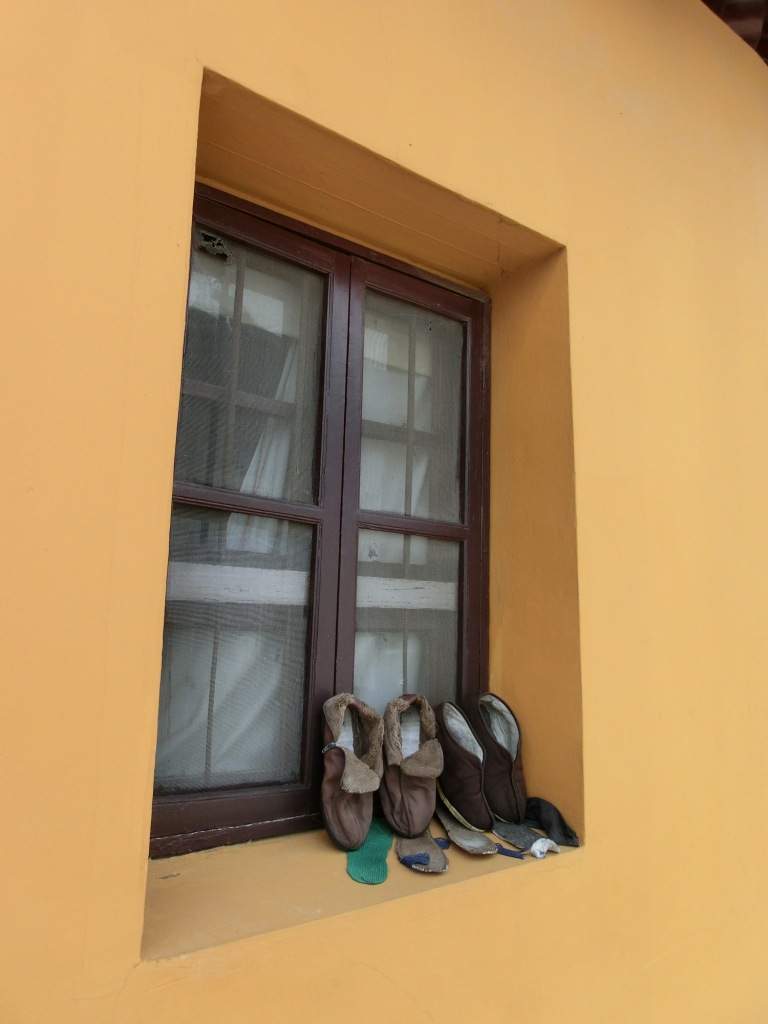
 Slippers carefully stood in the windowframes to dry in the sun.
 A doorway to living quarters of some sort.
 The vegetable garden, outside the temple walls.
Robes, hanging as laundry to dry at the edge of the garden.

LingYan Shan

 The opening of the Subway has made it much easier to travel to the far West side of Suzhou.  Back in February, I took the city bus over to Tian Ping Shan.  It took about an hour and a quarter.  Now, it's just a 30 minute subway ride to the Mudu Terminal.  From there, it is just a short bus or taxi ride to Tian Ping Shan or the old section of Mudu or any of the other attractions in that area. 
 LingYan Shan is another one of the "shan", or big hills, that form the Western limit of the Suzhou metropolis.  (In Southeastern Indiana, these rocky hills would be called "knobs") LingYan Shan sits just to the South of Tian Ping Shan and is but a 10 minute walk from Old Mudu.  The top of the hill is about 600 feet above sea level....which means it rises about 590 feet above the surrounding countryside. The tree- covered knob and the encircling strip of green space provide a place for local folks to escape from the city and enjoy some hiking.  During the summer months, the cool shade of the trees provides a little relief from the heat of the concrete and asphalt.
 LingYan Shan also attracts some tourists and religious pilgrims

At the top of the hill is an old Buddhist temple and along the paths upward are several shrines and such.  The name - LingYan Shan - translates to something like "Spirit Rock Hill".  It seems that the people of China have considered mountains to be sacred places since the dawn of their civilization.  Over the last 2500 years or so of Buddhism, Taoism, and Confucianism, just about every hill higher than a speed bump has had some type of temple or shrine built upon it.  The most famous of these are the Sacred Mountains of China, of which there are five...or four...or eight...or thirteen. (Depending on who is counting.)

The temple on LingYan Shan was founded sometime around 500 A.D.  I don't know how old the current buildings are but I doubt they are nearly that old.  The structures are made mostly of wood.  The Buddhist tradition for the faithful is to burn offerings in cauldrons out in front of the buildings.  Temple fires, in my understanding, were quite a frequent thing over the years.
 From the foot of LingYan Shan you have two choices for going upwards.  You can take the paved path or you can take the stairs.  The stairs are the most direct way to the top, but require more exertion to climb.  The paved pathway is no picnic, but takes a longer, winding route to reduce the incline.  The stairs and the path intersect each other at a number of points along the way.  You can see the stairs above and the paved path below.
 The paved path features several prominent shrines and seems to be the more traditional way for pilgrims.  You can see a monk in his yellow robes in the photo above.   I saw one woman coming up the path wearing knee pads.  She would take four steps, and then clasp her hands in a prayerful gesture to heaven.  Then she would get down on her knees and prostrate herself in the direction of peak.  She would rise to her knees with clasped hands and then low low again for a total of three times.  Then she would stand up and walk four more steps, and then repeat the whole ritual. From the bottom of the hill to the top.  Four steps at a time.  It must have been a long day for her.
For those who have more to spend and less to atone for, there are easier options for getting to the top.

 At the top, or nearly at the top of the peak is LingYan Temple.  (By the way, there is another LingYan Temple, a much more famous one, near Mount Tai in ShanDong province.)  The temple complex features a the main temple and a number of smaller side ones and a fairly impressive pagoda.  The most interesting thing, though, is that seems to be a fairly large and active contingent of monks there.  Most of the buildings seem to be dormitories and other living quarters.  And you can see the monks out working on the hillside, tending to their gardens or trimming back the encroaching trees.  LinYan Temple seems to be an active Buddhist community and much less of a tourist attraction than some of the other temples we've seen.
 If you climb a little further from the temple, you can get a pretty good view of the surrounding city.  That is what most people come for, I think.
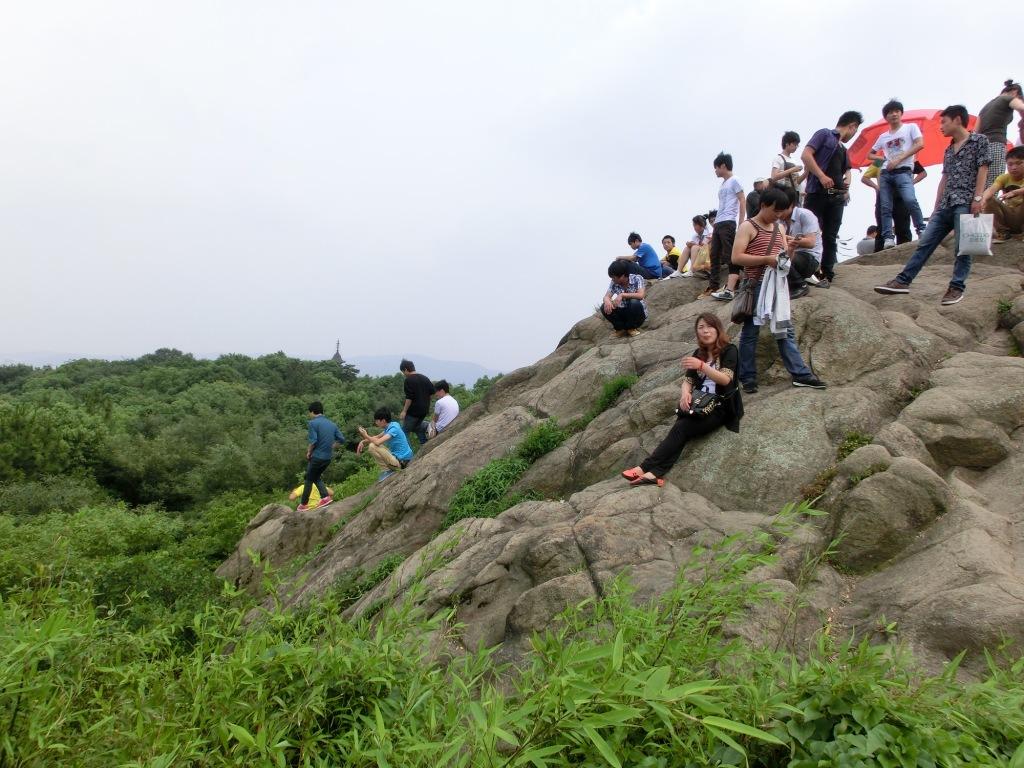
The people will go anywhere and do anything to get a perfect view.  I don't know if it is a fearlessness in the Chinese spirit or a lack of personal injury lawyers, but the local folks seem to have no problem to perch on the edge of cliff, as far out onto the rocks as they can go.  It reminds me of the old photos of Civil War soldiers perched on Lookout Mountain.  I think, maybe, the perfect view that the daredevils are looking for is one without 50 other people in front of them.
 The photo below shows one of the shrines along the pathway to the top.  It is difficult to see, but this small building covers images of the Buddha and some animals that have been carved into the natural rock.   It's a grotto, I guess, though not a natural one in a cave or a cliff side.
 The photo below is another shrine.  Actually, it seems to be a small temple unto itself.  This small shelter is surrounded by a walled courtyard.  There is not room enough inside for more than 4 or 5 persons at a time.
 Normally, I've sworn off photography inside of temples where people are actually worshiping.  I'm following the rules of the Cathedral of Strasbourg; It's generally ok to snap photos, but none allowed during times of actual Mass.  The problem, though, is Buddhist don't do a scheduled Mass.  The temples are open to active worship at all times.  So if there a lot of people around praying (and there usually are) then I try to be respectful. 
 This temple was small enough that there were no other people inside.  So I figured fair game for photos.  Also, the statue inside was remarkable in that it was so small - only about 10 to 12 inches high.  With a very unusual gold statue involving a god of some sort and a fish.  I'd guess there is a good legend which explains all this, but I don't know what it is.
 You can tell the significance of a temple by the quantity of stuff burning in the offering pits outside.  This small shrine must be a significant one, because there was a great fire pit of about 8 feet by 40 feet and a candle shelter that must have been 40 or 50 feet long.  Much more was being burned here than at the temple at the top of the mountain.
This small temple is located in a midst of a large bamboo grove.  The bamboo in the photo above are probably 5 or 6 inches in diameter and tower 50 feet or more into the air.  Since bamboo groves are not that common in Indiana, I'd never realized that the plants create a fairly good canopy with their leaves.  A bamboo grove is a rather cool and comfortable place to spend some time on a hot, sunny day.  Especially after the equivalent of climbing the stairs to the top of a 50 story building.

Sunday, July 29, 2012

Summer Smog

Normally, the Plum Rains come in June and last until the first of July.  That's certainly the way it played out last year, when it rained most every day in the last three weeks of June.  Then it got hot - stinking hot and humid.

This has been a strange summer, weather-wise.  The June rains never really came.  It stormed from time-to-time, but fell well short of the rainfall of last year.  As June passed into July, the summer heat didn't really kick into gear.  I wouldn't say that it was cool in Suzhou, but it was certainly cooler than normal.  The daily temperatures topped out at about 90 degrees - 95 degrees at the most.  And the humidity was merely oppressive, instead of downright murderous. 

(While the U.S. Midwest was suffering through hotter than normal temperatures, many places in the rest of the world have been running a bit cooler than normal.  Suzhou has.  Northern Europe, too, has been having a cold, wet summer...at least according to my French, English, and Danish colleagues. )
The smog has been brutal, though.

More often than not, it is hazy in this part of China.   The high humidity is mostly to blame.  Pollution contributes.  But the hot, humid, continental air and the ocean breezes from the East are the main culprit.  Blue skies are a rare thing. Normally the skies are steely grey and overcast in the mornings.  The sun burns away much of the haze by afternoon.  Then, the heaviness returns as the air temperature falls to toward the dew point in the evening.

This June and July, though, there have been days in which the haze lasts all day long.  It's like being in a cloud.  The sun is just a pale white-orange disk, if you can see it at all.  And the colors of the world are a washed out to shades of grey, almost like at dusk.

The photos posted were taken on a day that was probably the worst we've seen in our time here.  They were taken in mid-afternoon, at what should be the height of daylight.  You can see how haze shrouds and  obscures everything.  I think, too, that the camera actually makes it look better than it does to the naked eye.  (In the photos, I can see buildings that I don't remember being able to see on my own.)